Mexican Border Basics
by Derrell S. Peel, Oklahoma State University Extension
Prior to the border closing in November 2024, US imports of Mexican cattle had averaged 1.18 million head annually in the previous decade (Figure 1) and 1.12 million head per year in the previous 35 years. Mexican cattle imports equaled 3.4% of the total US calf crop from 2015–2024, and 3.1% since 1990. The brief border opening in 2025 allowed about 230,000 head to cross, which was 0.7% of the 2025 calf crop.
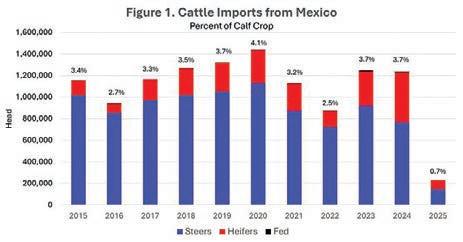
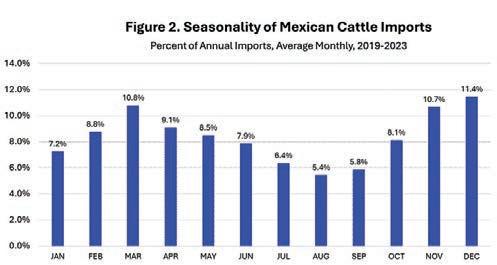
Figure 2 shows the average seasonal pattern of Mexican cattle imports from 2019–2023. The typical pattern is bimodal with peaks in March and again in November and December. Calves carried over from the previous year are typically exported in the first half of the year, with relatively few exported in the heat of the summer. New crop calves start to be exported in the final months of the year, carrying over into the next year.
The last year with a fully open border was 2023. The largest port cattle came through was Santa Teresa, New Mexico, which accounted for nearly 43% of cattle crossing. Along with the Columbus port, New Mexico accounted for over 53% of total cattle imports. The ports at Nogales and Douglas in Arizona represented another 27.5% of cattle crossings. The six ports in Texas accounted for a total of 19.2% of total Mexican cattle imports. The largest Texas port is Presidio/Ojinaga, accounting for 7.7% of the total.
Rumors are currently swirling that the border could open soon, probably with the phased plan to open ports from west to east over time. How much and how fast can cattle imports recover? The answer is: not very. It will take several weeks for border facilities to restaff, and have USDA-APHIS personnel in place to inspect and clear paperwork for crossing cattle. It takes time (and money) for Mexican producers to prepare cattle and the paperwork needed for crossing. It’s not clear how aggressive
Exactly what that recovery looks like, and the numbers expected, is uncertain. Mexico has continued to adapt since the border has been closed, utilizing previously exported cattle in domestic markets. Mexico has developed significant cattle feeding and packing infrastructure in the past 25 years. More infrastructure investment is underway. Mexico is the eighth largest beef producing country, and the seventh largest beef consuming country. The country is the number eleven beef exporting country, and beef exports have grown more than tenfold in the past 20 years.
Mexican producers will be initially, until they have a sense of how stable the border situation might be. By the time cattle can begin crossing, it will be close to the heat of summer, which is likely to limit crossings. If it starts relatively soon, numbers of cattle imports could begin to recover significantly by fall.
Exactly what that recovery looks like, and the numbers expected, is uncertain. Mexico has continued to adapt since the border has been closed, utilizing previously exported cattle in domestic markets. Mexico has developed significant cattle feeding and packing infrastructure in the past 25 years. More infrastructure investment is underway. Mexico is the eighth largest beef producing country, and the seventh largest beef consuming country. The country is the number eleven beef exporting country, and beef exports have grown more than tenfold in the past 20 years.
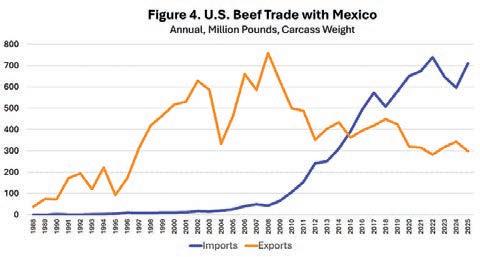
US imports of Mexican cattle are part of an increasingly integrated cattle and beef trade relationship between Mexico and the US. Mexican cattle imports have been important for many decades. In the 1980s, Mexico became a significant beef export market for the US, and is currently the number three beef export market (Figure 4). More recently, after 2010, Mexico has become a significant source of US beef imports, and is currently the number four source of beef imports (Figure 4). Cattle and beef trade between the US and Mexico are interrelated markets, so the current disruption in cattle movement across the border may have a variety of impacts in the future.
US-Indonesia Trade Deal
US beef exports will now have duty-free access to Indonesia. Gaining access to the Indonesian market, where US beef has faced significant barriers, has been a priority for organizations like the National Cattlemen’s Beef Association (NCBA) for many years. As part of the trade deal, Indonesia will purchase at least 50,000 metric tons of US beef annually and now recognizes USDA authority on food safety and animal health, opening more opportunities for exports.
“US beef exports to Indonesia have faced numerous tariff and non-tariff trade barriers, which has made it incredibly difficult to develop any type of market presence. With this agreement, American cattle producers now have access to the fourth most populous country, the largest halal beef market in the world, and more opportunities for producer profitability,” said NCBA President and Virginia cattle producer Gene Copenhaver. “When combined with the Taiwan trade deal signed last week, US cattle producers now have more market access than they have had in decades.” .