by Rose Oie
Shifting the focus from individual cow performance to whole-herd productivity can help producers find the “best” cow for their operation.
Female selection is often discussed through individual traits, but building a profitable cow herd requires looking beyond any one measurement. During Fall Focus 2026 in Bozeman, Montana, Dr. Ryan Rathmann of Texas Tech University and Dr. Troy Rowan of the University of Tennessee gave insight on what cow efficiency really means, and how female selection decisions affect the entire operation.
The conversation brought up a familiar challenge in the beef industry. Market signals on the terminal side continue to reward cattle with added gain and frame size with an end result to produce heavier carcasses. At the same time, those same genetic changes can increase the size and maintenance requirements of the females being retained in the cow herd.
Both professors described this as a “tug of war” between the terminal and maternal sides of the industry. Genetic progress has contributed to heavier cattle and improvements in carcass value, but it has also been accompanied by increases in mature cow size, milk production, and maintenance requirements.
“The problem is that, again, some of this gets kind of gray in the cow herd,” Rathmann said. “Because what we have done is we have unfortunately created a female in our industry that is somewhat built on current extremes.”
For the commercial cow-calf producer, the question becomes whether those additional inputs are generating enough additional revenue to justify them.
Finding the Balance
Rathmann used a series of economic comparisons to show how cow size and milk production can affect the number of cows an operation can support on a fixed land base.
The handout compared mature cow weights ranging from 1,100 to 1,400 pounds, and peak milk production levels of 11, 18, and 25 pounds. The exercise held the amount of forage available constant, allowing the comparison to show how different types of cows would use the same resource. 
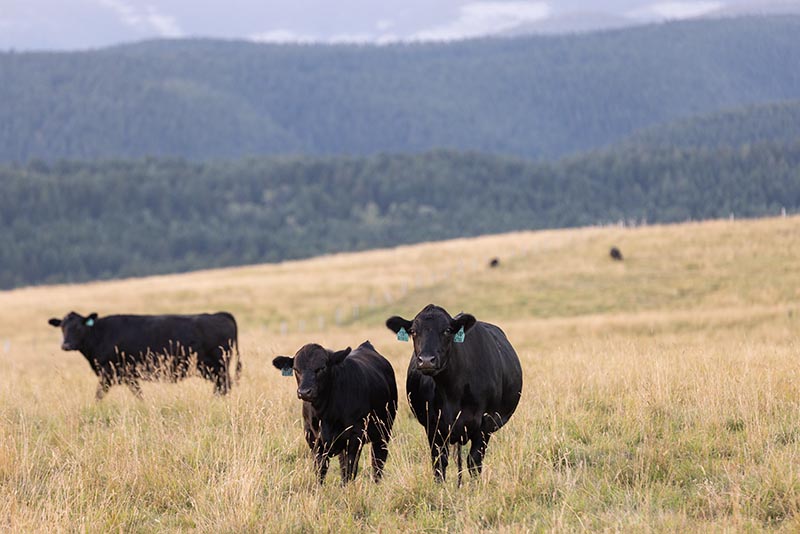
Above: Dr. Ryan Rathmann discussed the various factors producers must consider when determining the best cow for their operation. Opposite: Finding the balance between cow size and productivity is a challenge for all producers.
Rathmann framed the exercise around a simple question: “What combination makes the commercial producer the most money, utilizing the same amount of grass?” A larger cow may produce a heavier calf, but she also requires more forage to maintain herself. If the additional pounds of calf do not offset the additional resources required to produce them, increasing cow size could ultimately hurt you more economically in the long run.
Rathmann reminds us that maximizing output is not necessarily the same as maximizing profitability. “It’s not so much about who is maximizing the output value of their cattle. It’s who is minimizing the input of their cattle,” he said.
His simulation showed the effect clearly. Moving from a 1,100-pound cow to a 1,400-pound cow increased annual forage requirements while reducing the number of cows that could be maintained on the same land base. The smaller cows produced lighter calves individually, but the greater number of cows supported on the fixed forage supply resulted in more total pounds of calf produced across the ranch.
The comparison illustrates why looking only at weaning weight per cow can miss part of the economic picture. “Cow efficiency” has to be considered at the herd and ranch level.
More Milk Is Not Automatically
More Profitable
Milk production presented a similar question. Rathmann’s analysis compared cows producing 11, 18, or 25 pounds of peak milk. Increasing milk production requires additional nutrients, but the relationship between milk and profitability is not necessarily linear.
His simulation found that the most favorable level depended on whether the additional milk affected pregnancy rates. When a reduction in reproductive performance was included in the model, the intermediate milk level provided the highest gross return per acre. When pregnancy rate was held constant, the higher milk level performed differently.
The larger takeaway was not that one milk level is universally correct. Milk production needs to be considered within the environment where the cow will be expected to work. Rathmann said producers need to be cautious about relying too heavily on any one measurement without considering the trait and environmental limitations of their individual herds.
The same principle applies to other traits. Producers have to determine where their own thresholds are and how individual traits fit into their production system. “That's your job to figure out, as the breeder, how you balance all of that.” Rathmann said.

Dr. Troy Rowan shared about the challenges of measuring individual cow intake, emphasizing the importance of future research.
Efficiency Is More than a Mature Weight
Rowan built on the discussion by looking beyond mature size and maintenance requirements. Fertility, longevity, structural soundness, immune function, the ability to convert forage into a weaned calf, and the ability to remain productive within a specific environment all contribute to the value of a cow. The challenge is that some of these traits are easier to measure than others. For example, mature weight can be recorded and incorporated into genetic evaluations. Individual cow intake on pasture is much more difficult to measure. Rowan’s research focused on why intake may deserve more attention.
Research evaluating individual cow appetite found considerable variation among cows of similar size. In one study, cows of approximately the same weight consumed substantially different amounts of dry matter during a 49- day period. Rowan used the example to show that body weight alone does not tell the whole story of how much forage an individual cow will consume.
Rathmann pointed to this as an area where the industry still has work to do. “We have to figure out technologically how to start capturing this information on cows on grass,” he said, “so we can start to identify these genetics.” Being able to measure individual intake and identify cows that use forage more efficiently could give producers a better tool for making replacement and mating decisions.
Efficiency Without Sacrifice
Rowan’s research also examined differences in body capacity and frame size, finding differences in intake and energetic efficiency among the cattle studied. But the findings did not singly point toward selecting the smallest or shallowest cow.
Instead, the study supported the idea that female selection involves finding a balance between production and maintenance requirements.
Rathmann made a similar point throughout his presentation. The objective is not to eliminate milk, growth or other productive traits. It is to find animals that can combine desirable performance with the ability to function within the resources available to them.
“There’s an antagonistic relationship between fleshing ability and energetic efficiency,” Rathmann explained. “We’re trying to reach that compromise. We’re trying to find that happy medium in regard to body volume.”
With these things in mind, balance will look different from ranch to ranch. A cow working in an environment with abundant, high-quality forage has different nutritional challenges than one expected to travel long distances for limited forage and water. Rathmann pointed to grazing activity itself as another factor affecting a cow's maintenance requirements.
Selection Decisions
Have to Fit Each System
For seedstock producers, the discussion adds another layer to the responsibility of selecting and marketing genetics. The bulls and females produced today influence the cows that commercial producers will be managing for years. Rathmann encouraged breeders to keep in mind how traits like mature size and milk production will be expressed in the daughters retained by commercial herds, instead of focusing exclusively on traits that increase terminal performance.
At the same time, neither speaker suggested abandoning growth or carcass traits. Instead, they want you to find a better balance between the traits that generate value at harvest and the traits that determine how efficiently a cow uses resources throughout her productive life.
Rathmann also encourages breeders to think about how genetics can be combined rather than viewing maternal and terminal traits as opposing choices. “Is it possible to select for genetics that have downward pressure on mature weight while you simultaneously have upward pressure on carcass weight?” he asked. “They’re pretty closely related, but they’re not one to one.”
That opens the door to what Rathmann described as “curve benders”; cattle that can deliver strong growth early in life without continuing to increase in mature size at the same rate.
The end goal is not to make a “small cow.” It is to select a female that can become pregnant, raise a calf, remain productive and make efficient use of the resources available to her.
For producers making replacement decisions, that means asking a bigger question than “Which heifer is the biggest?” or even “Which heifer has the highest genetic value?” The more useful question may be: Which female is most likely to remain productive and profitable in the environment where she will spend her life?
This question brings female selection back to the economics of the entire cow herd. When land, forage, and other inputs are limited, the most productive individual cow is not necessarily the one that generates the greatest return for the ranch. Sometimes, efficiency comes from producing a little less per head while producing more from the resources available to the entire herd.