by Lilly Platts
The Jenson family operates an up-and-coming SimGenetics, Angus, and Gelbvieh seedstock business, built on decades of experience running commercial cattle.
Crossbreeding is a foundational element of the Jenson Ranch program, which focuses on raising seedstock that will work for the commercial producer. Jace Jenson’s grandfather and father both built the family operation, and he has since taken the lead alongside his family.
South Dakota Roots
Like many commercial operations, the Jenson family first ran Hereford cattle, which transitioned to an Anguscross, and eventually, a primarily black-hided herd. Located near the unincorporated community of Ralph, South Dakota, the Jenson family is close to eastern Montana, as well as southwest North Dakota. The open, Western prairie is productive grassland, and can also experience long, cold winter conditions. The Jenson family has homesteading roots in the Ralph area, with the current homeplace just three miles from the original family plot.
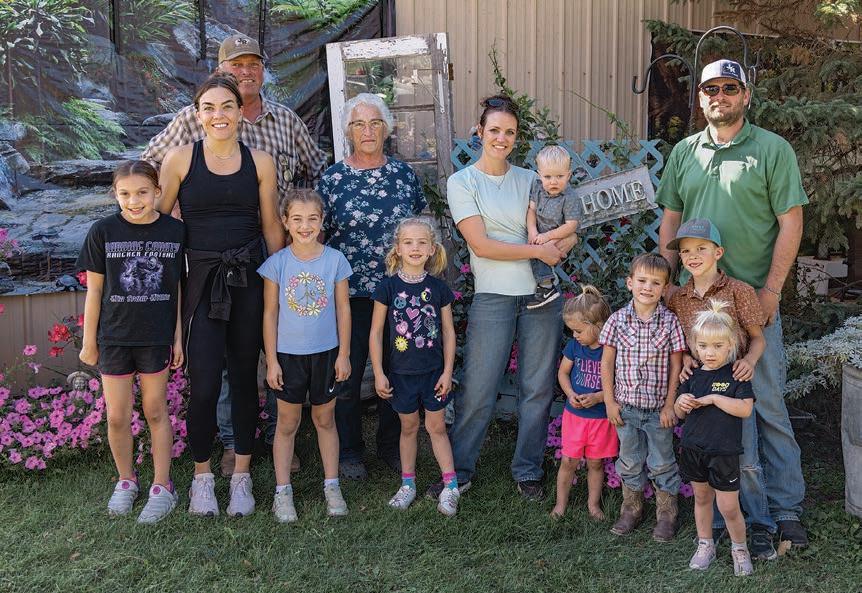
Jace Jenson grew up ranching. His grandparents, Jean and Louise, started the Jenson ranch, which was passed onto his parents, Ron and Starla. Today, Jenson and his wife, Cammy, along with their two young boys, are the third and fourth generations of the family business. “The goal for us is to continue making this generational. We hope to give it to our children someday,” Jenson shared.
With decades of experience in the commercial business under their belt, the Jensons had the opportunity to purchase registered females from Dave Graff and Wayne Wilson, which kickstarted their journey in the seedstock business. They have since built their registered cow herd, alongside the commercial operation.
The Jenson family’s registered herd has been built on their Angus cow herd, with the addition of Simmental and Gelbvieh. The Angus cow herd is used as the base, with Simmental and Gelbvieh crosses adding two crossbred options. “We try to keep an Angus base, and then stem off of that in both directions,” Jenson said. “That’s our main goal is to comprise the perfect combination of those breeds.”
These three breeds are balanced to make up their sale offering each year. The Gelbvieh breed was added to cater to a customer base, and Simmental has further expanded their offering. “Simmental was something we really wanted to get into, for the same reasons we like the Gelbvieh-cross cattle,” Jenson shared.
A Commercial Foundation
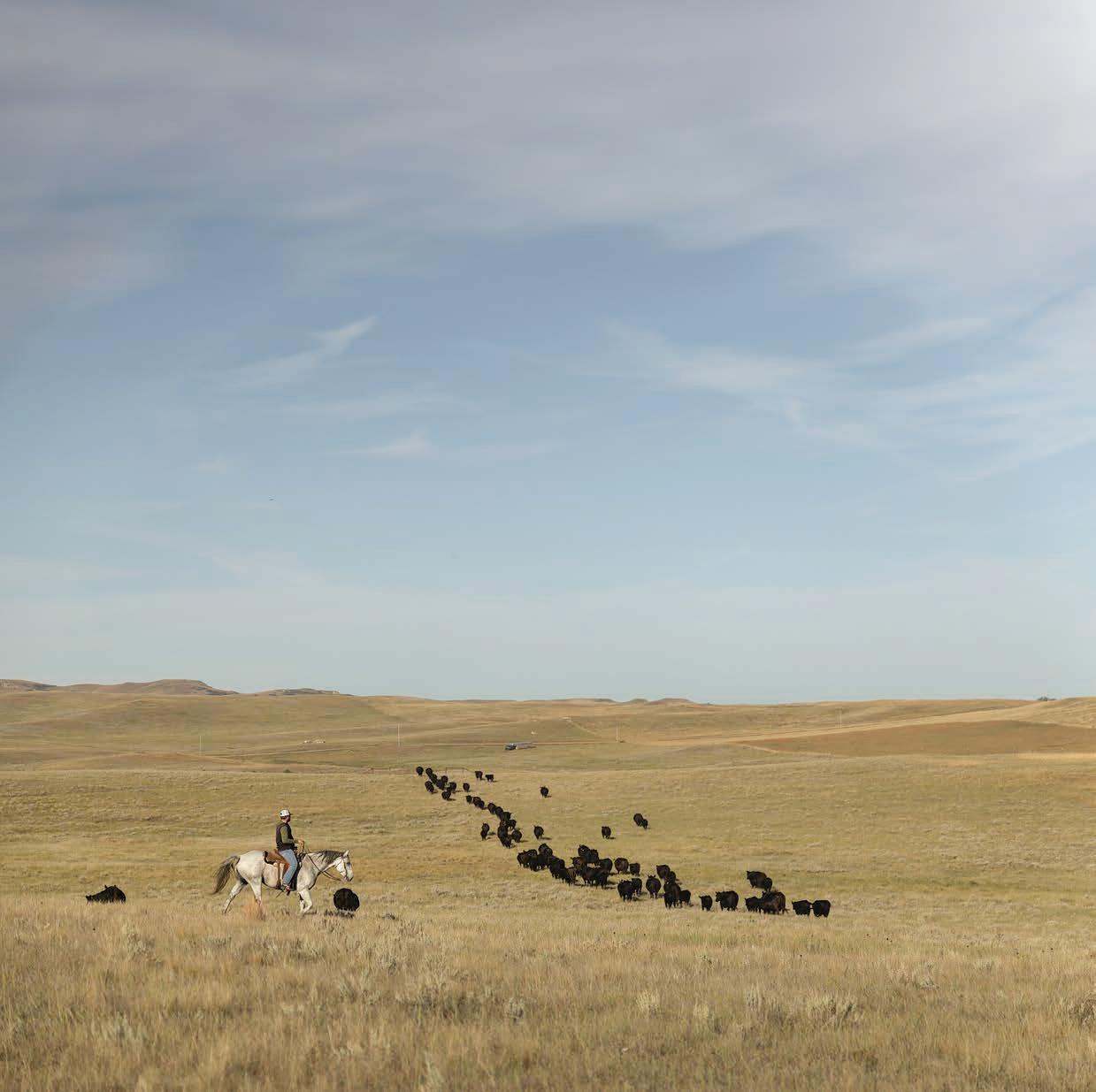
The Jenson family continues to run a group of commercial females, which not only diversifies their own operation, but also informs the decisions they make as seedstock producers. “The whole thing started with a commercial herd, and a lot of these cows are still commercial,” Jenson said. “We do the same thing as everyone else — we’re trying to sell pounds of calf off the cow without giving up maternal traits.”
The registered cow herd is run alongside the commercial females, which means they are required to meet the same standards of productivity and self-sufficiency. Crossbreeding has enhanced both the commercial and registered herds. The advantages of heterosis are top of mind. “There are a lot of things that come from it. There is added performance, fertility, and it makes a good commercial cow or seedstock animal,” Jenson explained.
Building a Business
Starting a seedstock business is no small feat, but the Jenson family is steadily building a dedicated customer base. “Everyone knows how hard it is to get into selling bulls,” Jenson shared. “It’s very stiff competition, and a tough market.”
Their sixth annual sale will be held in 2026. Dave Graff served as a guide to the Jensons in their early years. “We were fortunate to have Dave there for a year. He really helped us get through that first sale,” Jenson shared. “From then on, it’s been a live-and-learn situation. You’re always going to find things that could have been better, and things you shouldn’t have done. There’s a lot to learn in the business.”
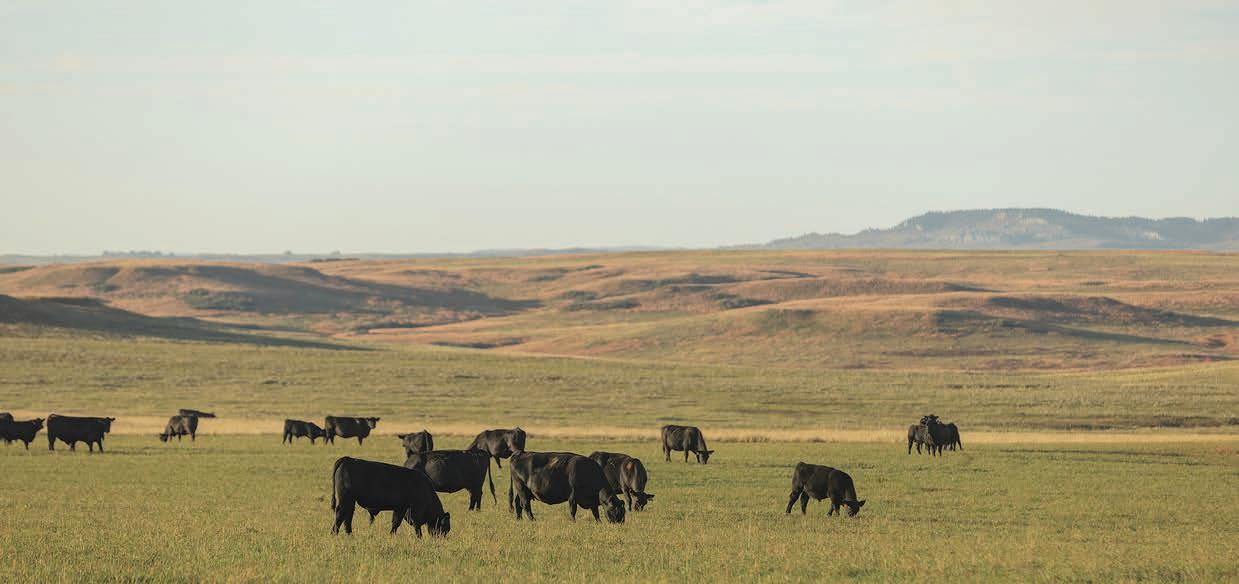
A high-quality, diverse offering has helped build this customer base. With Gelbvieh, Angus, and Simmental, there is something for everyone. “We’re able to offer a wider range of genetics to our customer base,” Jenson explained. “The quality has gotten better, and we are always trying to evolve and make the next generation better every year.”
The addition of SimGenetics to their seedstock offering has expanded their customer base, and also added diversity to their own operation. “The Simmental cattle bring a lot of good traits to the table,” Jenson said. “First and foremost, there is the performance side. I also think there are a lot of maternal traits that come along with those. The breed has evolved to really make phenomenal cattle, and for us specifically, crossbreeding makes the cattle that we like to run out here. Those cattle do really well.”
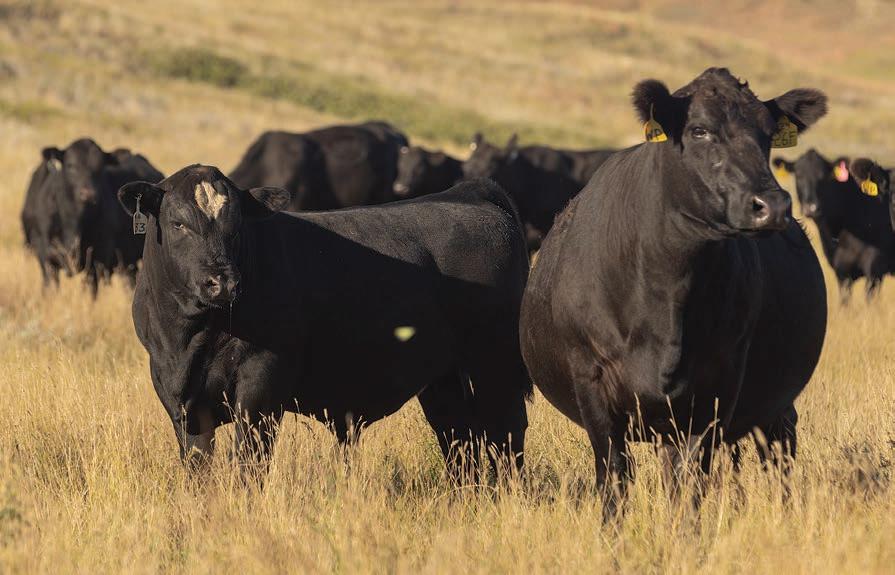
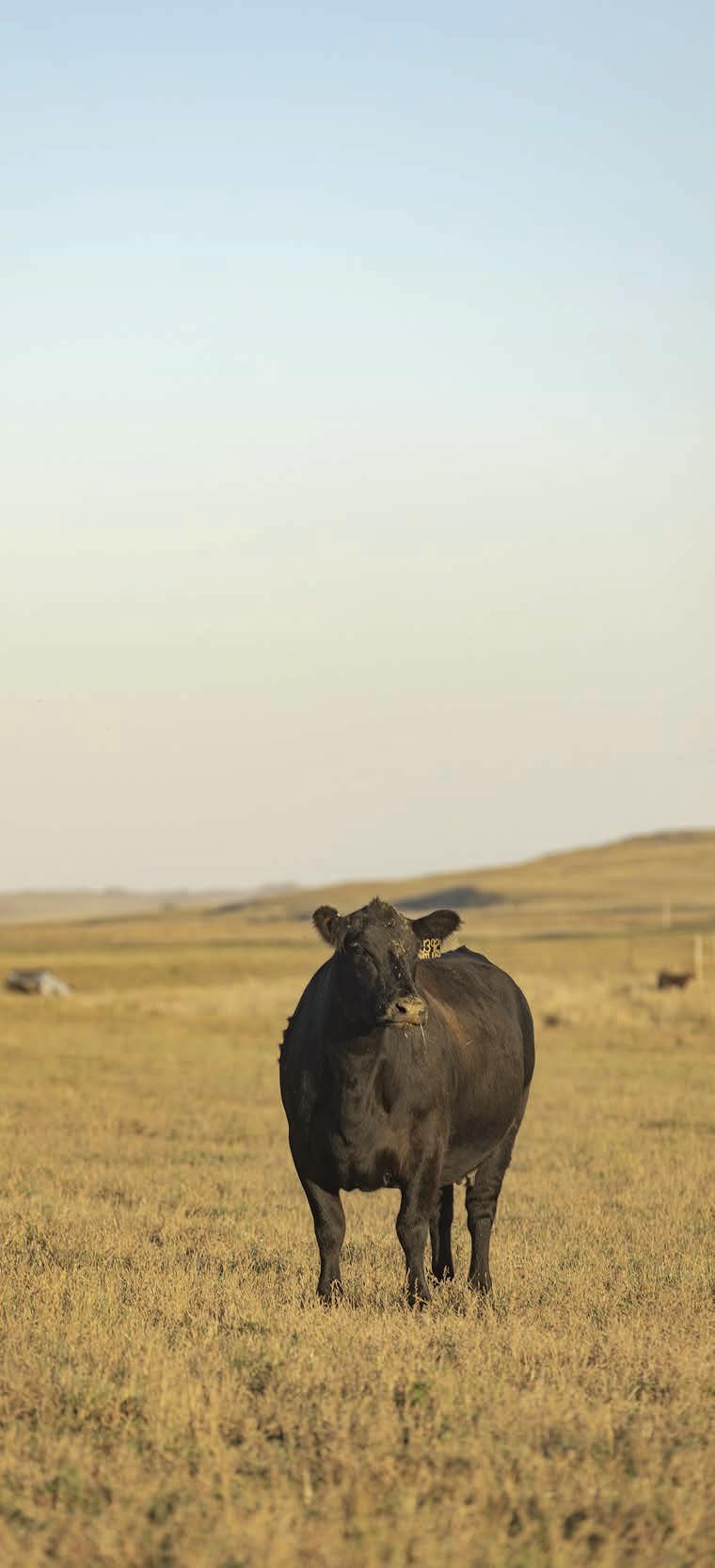
Above: Females at the Jenson ranch are required to be hardy and self-sufficient.
Left: The Jenson family continues to run a commercial cow herd, and values the benefits of crossbreeding both for themselves and their customers.
Opposite: SimGenetics were added to the Jenson program to diversify their seedstock offering.
Like many in their region, the Jenson family is largely focused on the commercial customer. The area is productive, but can also pose environmental challenges like drought or extreme winter conditions. Because the Jensons run their cattle in the same environment, bulls are ready-made to go out and succeed. “They [our customers] ranch in a similar way to us. They’re striving for the genetics that we are striving for. Most are selling pounds one way or another,” Jenson said. “We try to make the best cows that we can. The bulls are somewhat a byproduct of making those females.”
The Jenson family works with cooperators, utilizing AI and ET work to expand on their offering. With both spring- and fall-born bulls, they are able to offer a select group of older bulls for customers who require a more mature sire.
The Cow Comes First
As seedstock producers, the Jenson family keeps a finger on the larger trends of the industry, and endproduct demand. Their commercial customers are simultaneously working to optimize cow profitability, while also raising the kind of cattle that will succeed in the feedlot. Crossbreeding helps to balance this demand both for the Jensons and their customers. “Crossbreeding in general is going to increase the overall performance of an animal,” Jenson shared. “In our operation, there is a fine line because we have to make females that will get us as much performance as possible without giving up the functionality of the cow herd.”
In southwest South Dakota, a cow that fits this bill has to be hardy and efficient. “She has to be able to go out in our part of the world and cover country, maintain her condition, and do a good job,” Jenson said.
Consistent, accurate recordkeeping helps the Jenson family track this cow herd performance. With the help of Data Genie, data is recorded and submitted to ASA through Total Herd Enrollment. Collecting and submitting both pedigree information and data on both the commercial cow herd and registered females helps the Jensons ensure that their genetics will work for their commercial customers. “I want to evaluate our cow herd all in one. I don’t care if they’re registered or commercial. I want to see how they’re stacking up against each other,” Jenson explained.
DNA collection and genomically enhanced EPD have also spurred this progress. “Getting genomically enhanced EPD on the whole herd — not just the registered cattle — gave us a baseline we can work off,” Jenson said. “What intrigued us the most was finding out where we were at, and actually using numbers in the selection process to improve in areas we are lacking, or seeing where we can give in other areas, to try and build the most balanced cow herd we can.”
The benefit of genomic testing gets passed on to Jenson Ranch customers, with more accurate EPD predictions. “It stems down to our customers,” Jenson explained. “We are able to make improvements in our herd, which helps our customers.”
The Jenson family is focused on improving the next generation of the cow herd, as well as their family’s future. “The whole operation is very family-oriented,
and our vision is to keep this thing going until we have the opportunity to pass it on to the next generation. That’s what all parents want, is for someone to come back and have an interest in what we’re doing,” Jenson said.
Working in the beef industry is challenging, but overwhelmingly rewarding for the Jenson family. “The beef industry is not always the easiest. It’s ups and downs, and can be a roller coaster. But the people who are in this industry are very optimistic, and there is a reason people do this. It can be very rewarding,” Jenson concluded. “It’s your willpower, and what you want to do. You’ll succeed if you put the work in.”