Feedlot Production Continues to Decline
by Derrell S. Peel, Oklahoma State University Extension
The September 1, 2025, feedlot total was 11.08 million head, down 1.1% year-over-year, and the tenth consecutive monthly decrease compared to one year earlier.
Feedlot inventories continue to decline slowly. Average inventories the past year are down just 3.1% from the peak in 2022, but the September 12month moving average is at the lowest level since January 2019. With the September on-feed total up slightly from the previous month, the August total was likely the seasonal low for the year. The feedlot inventory on August 1 this year was the lowest monthly inventory since October 2017.
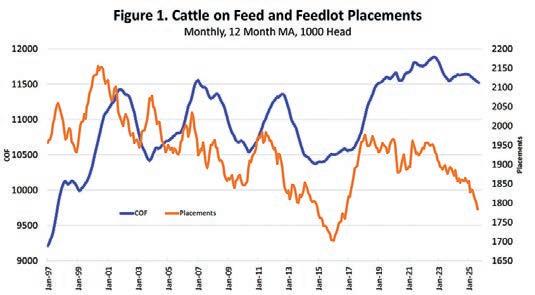
Total feedlot production is declining more rapidly than the slowly declining feedlot inventories would indicate. Feedlot placements in August were 90.1% of last year, and the smallest August placement total since 2015. Figure 1 shows the relative comparison between 12-month moving averages of cattle on-feed and feedlot placements. Placements have declined more than the on-feed inventory up to this point aided by a slower turnover rate in feedlots.
August marketings were down 13.6% compared to last year. Feedlot marketings for the first eight months of 2025 are down 5.4% year-over-year. Average feedlot marketings the past year are down 8.2% from peak average marketings in 2022. Smaller calf crops and limited feeder cattle supplies mean there is less cattle available for feedlot production. Feedlot production and beef production are expected to continue to decline into 2027.
USDA’s Beef Industry Plan: What Does it Mean for the Small Processor
USDA Secretary Brooke Rollins has released the long-awaited plan to fortify the American beef industry. The USDA plan aims to grow the herd, and reverse the shrinking number of cattle ranchers in the country. Other elements are targeted at the beef processing industry, including offering new grants, increased access to remote beef grading, and reducing inspection costs for small processors.
“I see things in the announcement that will have a positive impact on our members long-term,” said Chris Young, American
Association for Meat Processors (AAMP) Executive Director. “The combination of new grant funds, low-interest loans, and a reduction in overtime inspection costs are all things that will help the small processors’ bottom line and make their businesses more sustainable. Being able to add production space or automation will allow them to increase production and meet growing consumer demands for beef and other proteins.”
Focusing on the elements of the plan that involve enhancing local processing and aiding small processors, there are many potential benefits for small processors, including the announcement of a fourth round of grant funding through the Meat and Poultry Processing Expansion Program (MPPEP). The first two rounds of the grant program helped many AAMP members advance their growth plans, whether through the purchase of new processing equipment or expansion of their facilities. This new program, which will focus on promoting local supply chains, will total up to $2 million per award. As many as 50 small meat processors across the country could receive funding to diversify the beef supply chain and open local market opportunities. USDA will strategically direct funding to areas that have a lack of local processing but have a demand for these smaller processors.
Additionally, the USDA’s Agricultural Marketing Service (AMS) will expand its remote grading program for beef, targeting small and medium processors that supply local and regional markets. The AMS will also expand its Instrument Enhanced Grading program, which leverages camera technology to improve the consistency and accuracy of the AMS grading program and reduce staffing needs, bringing costs down for meat processors of all sizes. Several AAMP companies have utilized this technology already, and it has allowed small butcher shops to sell Prime and Choice beef without the significant costs of bringing a USDA Grader to their facility.
During the COVID pandemic, the Food Safety and Inspection Service temporarily reduced the costs of overtime and holiday inspection for small and very small establishments. AAMP was a proponent of this initiative, as it helped offset the costs of keeping up with the demand for meat that members experienced. The agency will again reduce those fees by 75% for very small processors, and 30% for small processors.
Tallow Tops Food Trends at Whole Foods Market
Whole Foods Market’s Trends Council recently unveiled their top food trends for 2026 in the retailer’s annual Trends predictions report. Whole Foods Market predicts 2026 the year of fiber frenzy, fine-dining freezer finds, and an uptick in tallow. These and more are set to influence the food landscape in the coming year.
The Whole Foods Market Trends Council—a collective of Whole Foods Market team members ranging from foragers and buyers to culinary experts—develop these trend predictions each year through a combination of deep industry experience, keen observation of consumer preferences, and collaborative sessions with emerging and established brands. “Each year, our Trends report captures the pulse of what’s next in food, and 2026 is no
exception,” said Sonya Gafsi Oblisk, Chief Merchandising and Marketing Officer at Whole Foods Market. “This year’s trends highlight how curiosity, creativity, and conscious choices are shaping the way people eat and shop. We’re inspired by the innovation we’re seeing across the food landscape and can’t wait to watch these ideas come to life in our aisles and beyond.”
“Our trends predictions are inspired by the council’s deep expertise and boots-on-the-ground discovery — at farmer’s markets, industry trade shows, local restaurants, and more,” said Cathy Strange, Ambassador of Food Culture for Whole Foods Market and member of the Trends Council. “The 2026 list reflects how quickly ideas can move from emerging concepts to everyday
favorites. It’s exciting to see how these trends will shape conversations in kitchens, communities, and the broader food culture in the year ahead.”
From whipped to herb-infused varieties, beef tallow is making a comeback as a nourishing and nostalgic fat. Once a staple in traditional cooking and prized for its high smoke point and rich flavor, tallow is being rediscovered by consumers who value ancestral ingredients and are looking for oil alternatives. This old-school fat is having a moment on social media, though it’s actually been used for centuries for frying and baking. Restaurants have also been trading in traditional oils for tallow to elevate everything from french fries to pastries. And for customers supporting “nose to tail” use of the animal, these brands provide a usage for fat that is normally discarded.
Gallup Poll Shows Consumer Trust in Food Safety at All-time Low
Since 1999, Gallup has been collecting data on the American people’s trust in food safety measures. The latest data, collected in July 2024, shows that only 57% of US adults have either a “great deal” or “fair amount” of confidence in the government’s ability to ensure food safety. Of the respondents, 14% have “no confidence at all.” Previous Gallup polls, spanning a decade, showed that around 70–80% of people were confident in food safety.
Food recalls have been high in recent years, likely leading to this drop in confidence. In the first six months of 2024, over 500 food products were recalled. Previous data showed parents and non-parents having similar confidence in food safety, but the latest data shows a widening gap between these groups. Recalls of food intended for babies and young children have increased in recent years, likely explaining this difference.
Is Your Hay Supplying Enough Vitamin A this Winter?
University of Nebraska–Lincoln
Vitamin A plays a critical role in young calf health. Calves are born with very limited vitamin A stores because little transfers from the dam during gestation. Newly born calves rely heavily on colostrum for their supply of vitamin A, making the cow’s late-gestation diet critically important. Milk is a poor source, so calves depend on the colostrum for their vitamin A supply for the first few months of life.
For most herds calving in late winter or spring, cows are fed stored or stockpiled forages during their last trimester. Recent research suggests that late-gestation cows need 75,000 to 90,000 IU/d of vitamin A, but the amount of vitamin A in hay varies widely. Factors such as forage type, maturity at harvest, haying and storage conditions, as well as how long hay has been stored influence vitamin A levels. This can mean supplementation needs range from none at all to nearly the full requirement coming from a supplement.
Color Can Be a Clue
Greener hay generally contains more beta-carotene, and therefore more vitamin A, than bleached or weathered hay. It’s not a perfect measure, but it can give you a quick indication.