by Chloe Tolar
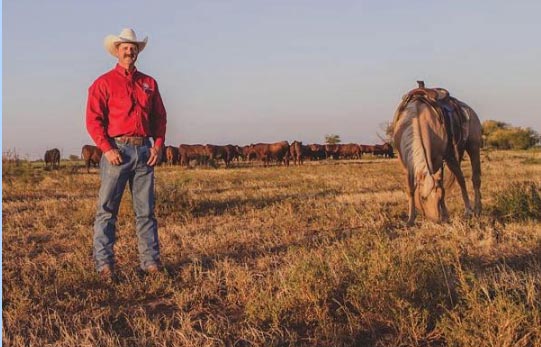
Donnell Brown has been involved in SimGenetics from a very young age, participating in AJSA events that helped shape his values, career, and future.
Editor’s note: This is the first article in a series highlighting the significance of the AJSA in Simmental breeders’ lives.
Donnell Brown grew up in Throckmorton, Texas, on the RA Brown Ranch. He was involved in showing and breeding Simmental cattle from a very young age, and was an active member in the Texas Junior Simmental Association (TJSA) and the American Junior Simmental Association (AJSA). He served as state and national FFA president in 1988 and 1989, and attributes his ability to succeed in those roles to his time spent with the AJSA.
Tolar: What was most memorable about your experience?
Brown: The AJSA was such a wonderful program to be part of; I learned so much. I attribute it to helping me achieve so many things in life and building so many relationships with people that I still do business with all over the country. It inspired me and built my passion to breed better cattle. Part of the passion the AJSA built in me was through serving on the AJSA Board, but even more so from the Sire Summary Quiz, the Herdsman Quiz, the Beef Bowl, Sales Talk, and Public Speaking. Those events really drove me. One of my best friends, Lorna Marshall, and I competed against each other from about age 13 to 21. She always won the Sire Summary Quiz and is now the head of acquisition for the largest semen company in the United States, which selects bulls.
Ryan Ludwigson is from Iowa, and we have stayed in touch ever since being involved with the AJSA. From 2011 to 2013, we leased a ranch together in Montana, ran cattle together, and had a bull sale. I could go on. There are so many people that continue to stay in touch, and they’re all doing great things in the cattle business.
On the national level, so many of my fond memories were from road tripping to junior nationals with all of my Texas buddies and studying over the CB radio. We would study Beef Bowl, Herdsman Quiz, and Sire Summary Quiz questions the whole way. The farther away from Texas, the more time we had to study and prepare, and the better we did.
What are the biggest skills you gained from participating in the AJSA?
The sales talk and public speaking definitely helped me. I was able to develop the comfort and confidence to communicate in a way that clearly shared a vision and inspired people to buy. That’s huge. Whether they’re buying cattle, an idea, or a philosophy, that became a huge part of being in the boardroom. Deciding who would be our judges, where we would have shows, where we would hold the events, and whether we need to consider a rule change. Having those conversations and discussions was mainly on the leadership side, but every member got to participate in the competition and hone the same skills to help them in life, like they helped me.
The additional events of livestock judging and reasons helped me grow in decision-making. You made a decision based on a scenario, and then you had to verbally defend that decision. All the contests gave us great skills to prepare us for a bright future.
Why are youth agricultural organizations like the AJSA important?
I think they’re huge in developing young people for success in life, but with the realization that not all of those people are going to be active breeders of Simmental cattle in their adult life. And that’s still a good investment because those people are being developed into leaders.
Through AJSA programs, we are developing leaders and leaders in life, regardless of where their career path takes them. When we build awesome memories from this organization, it helps build a passion to do great things and help the agriculture industry. So as we look at junior programs, we’ve got to look at what the return on our investment is. It’s not a cheap one, but it’s worth it to invest in young people who have a huge impact on the future of our industry. Whether it be in Simmental and raising Simmental cattle, or not raising Simmental cattle, I see them having a positive impact on the cattle business.
There are so many people I have participated with in the AJSA who are making a positive difference. We’re starting to see people who, as they retire from a successful career, are choosing to get back into the cattle business and use the things they learned in the AJSA to be successful cattle breeders as a second career.
How do the skills young people gain in the AJSA reach beyond agriculture?
I have no doubt that those skills have helped our ranching business be successful. We’re thankful to have had our 51st annual sale, and to sell SimGenetics at every one of those sales, in addition to other breeds. And the great thing is, Simmental is pro-crossbreeding. Simmental has consistently had a philosophy of being scientifically the best. And if that meant crossbreeding systems and using heterosis and breed complementarity, then absolutely, let’s embrace it. Let’s develop the best genetic evaluation system to identify the best genetics and improve the profitability and sustainability of our customers who use our genetics.
There’s no denying that those skills have helped us, helped me professionally, but they’ve also helped me relative to preparing to serve and serving in leadership positions at the state and national level of FFA president. Gaining the ability to communicate with people my own age as well as people much my senior, in a professional way, was very valuable. I “sold” FFA for two years. I sold it to young people to be active in the organization, to organizations to sponsor; it was a huge investment to help build leadership in young people. The AJSA helped me prepare to not just get elected, but to serve successfully to be the best that I could be.
How did your experience in the AJSA inform your career decisions?
It definitely helped me decide what I wanted to do. It also encouraged me to look way beyond my little hometown of 700 people. When I finished AJSA, I really thought that I saw myself becoming a lobbyist in Washington, DC, because I loved communicating with people. I loved sharing ideas, philosophies, and things that helped the agricultural industry, and that was a passion of mine. I felt like that was where I was headed.
Then, after my year as national FFA president, I realized that I might do that some, but that my calling was really at the ranch to produce the best cattle that I could, and to help people be the best they could be. I would not trade for the world working on the RA Brown Ranch, raising SimGenetics cattle, and raising our children in an environment where they learn so much about birth, growth, maturity, and even death in such a variety of ways that help them become better citizens.
What impact did the Simmental breed have on your breeding program?
I remember when EPD were first released and getting the accordion-style, dot-matrix, printed sire summary. That was the beginning of helping make wise management decisions through the genetic evaluation part of studying EPD and herdsmanship.
What I love about AJSA is that it’s more than just showing. It’s more than just a visual appraisal. It’s more than just sire summaries and EPD. It’s all of those things combined, and as I work with a lot of different breeds, we see people who are really good with sire summary, but might not know what a sick one looks like, or how to treat it if it were. And the AJSA program definitely helped me to be more successful at doing all of those things, in being a fullservice genetic provider, stockman, and ranch manager.
In the real world of livestock production, it’s important to have the phenotype, structural correctness, and genetic/ EPD profile that fits what your customer needs. So, in learning from the AJSA through livestock evaluation, it helped me put our sale catalog together and place 600 bulls. I need to put them in a logical sale order that helps the customers get the bulls they want.
Do you have any advice for a young person who is stepping into their first job or career?
When preparing for a job or position, prepare to do it to the best of your ability. Don’t just prepare to get the job, because when you prepare to do it to the best of your ability, you’re going to be a better person and be way more prepared.
Commit for at least three years. So many people have a tendency to change jobs more quickly and not stay committed, which makes it harder for those of us hiring to invest our best into them. If you commit for three years, then the employer is confident in who you are working for. You’ll make a more serious decision on what you’re going to do, and you’re going to get more out of it because of that commitment. The people you work for are going to put more into you because of that. And finally, do your very best with what you have while you’re there.